Dear Client:
Our Clients are asking us questions as we prepare their tax returns. We'll share some queries and our answers.
Are IRA management fees tax-deductible?
It depends. If you own a traditional IRA and pay the fees out of pocket, you can claim them on Schedule A as a miscellaneous itemized expense to the extent all qualified costs exceed 2% of AGI. You can't write off fees charged directly to the IRA. Roth IRAs are more complicated. The prevailing view is that Roth fees aren't deductible because they're incurred to produce tax-free income, whether the fees are paid with outside funds or deducted directly from the account.
How do I report fantasy football winnings? As hobby income, in most cases. You claim the winnings as other income on line 21 of your 1040. And if you itemize, you can write off related expenses on Schedule A, subject to two important limitations: First, your expenses are deductible only to the extent of winnings shown on line 21. Second, similar to IRA fees, they're reported as miscellaneous itemized deductions, and you benefit only to the extent total miscellaneous itemizations exceed 2% of AGI. Winnings are not hit by self-employment taxes because they aren't earned income.
Is a tax credit still available for putting energy-efficient windows in my home?
Yes, but it's limited. The year-end tax package extended this popular break for energy-saving home improvements through 2016. The credit remains at 10%, with a $500 maximum. Any credits taken in prior years count against the $500. And many items are capped: No more than $150 can be claimed for water heaters and furnaces, $200 for windows and skylights, and $300 for biomass fuel stoves. A juicier 30% credit for residential solar panels and other alternative energy systems is also available through 2016. Form 5695 is used to claim both of these tax breaks.
Since I converted my traditional IRA to a Roth last year, the account lost value.
Can I now undo the switch and trim my tax bill? Yes. You have until Oct. 17 to unwind it. If you do so before filing your return, then you'll avoid paying a tax bill. If you've already filed for 2015 and paid the tax, use Form 1040X to request a refund. Contact your IRA administrator for the steps needed to recharacterize the conversion.
I'm getting ready to file my 1040. What are the odds that IRS will audit me?
Pretty slim, but there are some red flags that could increase your risk. Last year, the Service audited only 0.84% of all individual returns. But the chances of drawing unwanted attention from the agency increase with various factors: Taking higher-than-average deductions. Writing off day trading losses on Schedule C. Underreporting income. Running a small business. Deducting rental losses or alimony. Claiming 100% use of a business auto. Failing to report foreign accounts. And more. Also, filers reporting higher income have a greater risk of audit than lower-incomers.
Foreign Asset
If you have lots of financial assets overseas, don't forget to file Form 8938 with your 1040. Joint filers living in the U.S. must attach the form if the value of their foreign financial assets exceeded $100,000 on Dec. 31 or topped $150,000 at any time during 2015. The thresholds are halved for singles and are much higher for filers who live abroad. Foreign financial assets include foreign investment assets, offshore bank accounts, foreign pensions and interests in foreign businesses.
Examples of these assets that must be reported if not held in an account include:
- Stock or securities issued by a foreign corporation;
- A note, bond or debenture issued by a foreign person;
- An interest rate swap, currency swap, basis swap, interest rate cap, interest rate floor, commodity swap, equity swap, equity index swap, credit default swap or similar agreement with a foreign counterpart;
- An option or other derivative instrument with respect to any of these examples or with respect to any currency or commodity that is entered into with a foreign counterpart or issuer;
- A partnership interest in a foreign partnership;
- An interest in a foreign retirement plan or deferred compensation plan;
- An interest in a foreign estate;
- Any interest in a foreign-issued insurance contract or annuity with a cash-surrender value.
Foreign real estate is not a specified foreign financial asset required to be reported on Form 8938. For example, a personal residence or a rental property does not have to be reported.
Go here to see a full list of what's reportable.
The penalty for failing to file the Form 8938 is high, starting at $10,000.
Working Abroad
Americans working abroad get a bit more tax relief on housing costs for 2016. The standard ceiling on the foreign housing exclusion increases to $14,182, up from $14,112 for last year. But workers in many high-cost locales around the world qualify for a significantly higher exclusion.
U.S. Economy
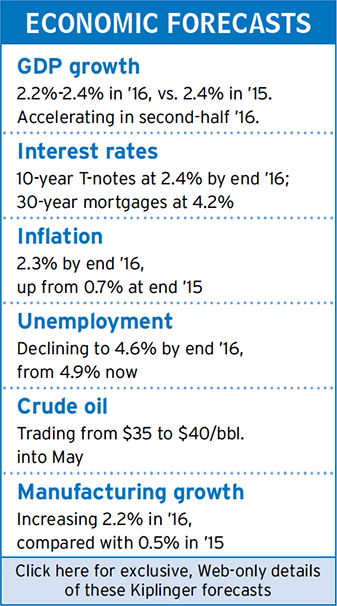
The economists and experts believe that the U.S. economy is likely to weaken in the near future owing to currency fluctuations in the U.S. Dollar. This may give a tough time to businesses to sustain their revenues especially those businesses that are new and/or less stable and weaker in their cash flow management.
As for the dwindling currency, the Canadian dollar at the present, stands at about 70 to 73 cents for one dollar and as a result is likely to affect the U.S. economy largely. It was only about eighteen months ago that the Canadian dollar stood at about 93 cents in the U.S currency. This change has alerted many investors, businessmen and tourists.
Moreover, the U.S. dollar is not expected to gain any significant hold in near future and is expected to remain in its present state with little or no fluctuation.
Tax Reminders:
Reminders for your 2015 return as the tax deadline nears:
The filing due date for most individual returns is April 18 this year because Washington, D.C., observes its Emancipation Day holiday on April 15. Filers in Maine and Mass. have until April 19 to file because Patriots' Day is April 18.
There are a few ways to get a six-month extension if you need extra time:
File Form 4868 by April 18 and add a check if you expect to owe tax. You can also e-file Form 4868 and pay the estimated tax owed electronically.
Use IRS's Direct Pay service and mark that the payment is for the 4868.
Or, for a fee, charge an extension-related tax payment on your credit card or debit card though an IRS-approved processor. The extended due date is Oct. 17.
If you're unable to pay the tax you owe, file your return or extension anyway to beat the 5%-a-month late filing levy. You can apply for an online payment agreement if you owe $50,000 or less in tax, penalties and interest, and you've filed all returns. Alternatively, use Form 9465 to set up an installment plan to pay your tax bill.
And keep in mind IRS's penalty abatement program for first-time offenders. Under its First Time Abate program, if a filer has paid or arranged to pay the tax due and has been tax-compliant for the past three years, IRS will OK a onetime waiver of the late payment and late filing penalties. Taxpayers have to ask for this relief.
Your IRA contribution for 2015 is due April 18. This date isn't postponed by a six-month filing extension. Payments by mail must be postmarked by April 18. Remember, the most you can contribute is $5,500 ... $6,500 for people age 50 and up.
Payins for Coverdell education accounts for 2015 are also due by April 18.
You can make Keogh payins by the extended due date of the return ... Oct. 17. But you must have established the plan before Jan. 1, 2016, to take a 2015 deduction. You may want to consider using a SEP-IRA if you didn't open up a Keogh plan in time. If you file an extension, you have until Oct. 17 to set one up and make a contribution for 2015. Both SEPs and Keogh contribution plans have the same payin limits.
Be wary of phone calls that purport to be from IRS. The Revenue Service and Treasury inspectors have issued warnings about a nationwide phone scam targeting taxpayers. Callers claim to be IRS employees and alter the caller ID readout to make it look as if IRS really is calling. Victims are being told that they owe taxes and must pay up fast or they will lose their driver's license, be arrested or deported.
IRS never makes unsolicited calls to people to tell them they owe more taxes or are due refunds. It contacts taxpayers first by mail. If you get one of these calls, notify Treasury inspectors at 800-366-4484. Also tell the Federal Trade Commission by filing a consumer complaint at www.ftc.gov and noting "IRS Telephone Scam."
Check out our site here.
Find out how you could earn upto $435 for referring a client to SK Financial by clicking here.
Finally, I would like to thank you by offering our marketing book:
57 Ways to Grow Your Business-
Bright Ideas for the Serious Entrepreneur
Yours very truly,
Shams Khan CPA, CFP