|
Dear Client,
Big changes are coming to the tax landscape in tax filing 2025 and beyond from enhanced deductions and new temporary tax breaks to expiring credits, shifting rules for businesses, and IRS relief for disaster areas. Whether you're an individual taxpayer, investor, small-business owner, or advisor, this update covers all the critical changes you should be aware of, including deadlines, benefits, and compliance tips. Stay informed and ahead with this breakdown of what’s changing, what’s ending, and where you may benefit in the new tax year.
|
|
|
2025 Standard Deduction Amounts
|
|
|
📢 IRS Disaster Tax Relief Summary
The IRS has extended tax filing and payment deadlines for disaster-affected areas:
- Missouri: New deadline Nov 3, 2025 (storms/flooding from May 16)
- Mississippi, Oklahoma & Texas (May–June): New deadline – Nov 3, 2025
- Texas (July disasters): New deadline – Feb 2, 2026
- New Mexico (from June 23): New deadline – Feb 2, 2026
Applies to federal returns and payments for individuals and businesses. For more information, visit the IRS tax relief.
|
|
|
|
2025 Standard Deduction Amounts
| Filing Status |
2025 Standard Deduction |
Increase from 2024 |
Additional Deduction (Age 65+) |
| Married Filing Jointly |
$31,500 |
+$1,500 |
+$1,600 per spouse |
| Single |
$15,750 |
+$750 |
+$2,000 |
| Head of Household |
$23,625 |
+$1,125 |
+$2,000 |
|
|
|
SSN Required for Key Tax Breaks
To claim many popular tax benefits, you must have a valid Social Security number. This includes the $6,000 senior bonus deduction, deductions for tip income and overtime, and education credits like the American Opportunity and Lifetime Learning credits. More deductions may also require an SSN.
Four New Temporary Tax Deductions Starting in 2025
A new tax law taking effect in 2025 introduces four limited-time deductions available through 2028. These apply to both standard deduction filers and those who itemize.
- Senior Deductions: Taxpayers aged 65 and older can claim a new $6,000 deduction. For couples where both spouses are 65 or older, the deduction is $12,000. However, it begins to phase out at a modified adjusted gross income (AGI) of $150,000 for joint filers and $75,000 for single or head-of-household filers.
- Tip Income Deduction: Up to $25,000 of qualified tip income can be deducted. This benefit starts to phase out at $300,000 of modified AGI for joint filers and $150,000 for others. The IRS is expected to issue guidance, as the rules may be complex.
- Overtime Pay Deduction: Workers can deduct up to $12,500 of overtime pay, or $25,000 if filing jointly. This deduction phases out at the same income levels as the tip deduction: $300,000 for joint returns and $150,000 for others.
- Auto Loan Interest Deduction: Borrowers may deduct up to $10,000 in interest on loans used to buy a new car, truck, SUV, van, or motorcycle, as long as the vehicle was assembled in the U.S. This deduction begins to phase out at $200,000 of modified AGI for joint filers and $100,000 for other filers.
These deductions provide short-term relief but are set to expire after 2028.
|
|
|
2025 Child Tax Credit Overview
| Category |
Details |
| Credit Amount |
$2,200 per qualifying child (up from $2,000) |
| Inflation Adjustment |
Yes – adjusted annually starting 2025 |
| Refundable Portion |
Up to $1,700 for lower-income filers |
| Child SSN Requirement |
Each child must have a valid Social Security Number |
| Filer SSN Requirement |
On joint returns, at least one spouse must have an SSN |
|
|
|
Child & Dependent Care Breaks
| Benefit |
2025 Limit |
2026 Update |
| Child & Dependent Care Credit (1 dependent) |
Up to $1,050 |
Up to $1,500 |
| Child & Dependent Care Credit (2+ dependents) |
Up to $2,100 |
Up to $3,000 |
| Dependent Care FSA Contribution Limit |
$5,000 |
$7,500 |
| Employer Child Care Credit |
Up to $150,000 |
Up to $500,000 ($600,000 for small biz) |
|
|
|
Updated Rules for Charitable Contribution Deductions
Beginning in 2026, new rules will affect how individuals and corporations can deduct charitable donations. Nonitemizers will now be able to deduct up to $1,000 in cash donations ($2,000 for married couples filing jointly), offering a new opportunity for those who don't itemize. Itemizers, however, will face stricter rules; only donations exceeding 0.5% of their adjusted gross income (AGI) will be deductible, although the current allowance to deduct up to 60% of AGI for cash donations remains permanent. For C Corporations, only contributions exceeding 1% of taxable income will be deductible starting in 2026, but both individuals and corporations can carry forward excess contributions for up to five years.
Itemized Deduction Limits Return for High Earners
Starting in 2026, higher-income taxpayers will once again see their itemized deductions reduced. The OBBB reinstates a modified version of the pre-2018 rule, which gradually reduces total itemized deductions for wealthier filers. In effect, it limits the value of those deductions to no more than what they’d be worth under the 35% income tax bracket, reducing the benefit for those in higher brackets.
Adoption Credit Becomes Partially Refundable
Starting with 2025 tax returns, up to $5,000 of the federal adoption credit will be refundable, meaning eligible families can receive the amount even if they owe no tax. This portion will also be adjusted annually for inflation, making the credit more accessible to lower-income adoptive parents.
|
|
|
Bigger Tax Breaks for Small-Business Investors
Beginning July 4, 2025, the tax benefits for investing in Qualified Small-Business Stock (QSBS) will improve significantly. Investors will be able to sell QSBS after just 3 or 4 years and still receive partial capital gains exclusions, instead of waiting the full 5 years. The cap on tax-free gains will rise from $10 million to $15 million or 10 times the investment basis, whichever is higher. Additionally, the criteria for a business to qualify as a small business are being relaxed, making it easier for more companies and investors to take advantage of this incentive. These updates apply only to QSBS acquired after the effective date and are intended to promote long-term investment in small businesses and startups.
Clean-Energy Tax Credits Are Ending Soon
Many clean-energy tax credits are expiring soon. EV and commercial vehicle credits end after Sept 30, 2025; home upgrade credits expire after 2025; EV charger and construction incentives end mid-2026; and large project credits phase out 2026–2027. Most work must be completed before these dates to qualify.
Higher Tax on Wealthy Private Colleges
Starting in 2026, private colleges with large endowments will face a higher excise tax on their investment income. The rate will vary 1.4%, 4%, or 8% based on the value of their non-education-related assets per full-time student.
2025 Business Tax Breaks Made Permanent and More Generous
The 2025 tax law makes key business tax breaks permanent and expands others. Highlights include the 20% QBI deduction, higher Section 179 expensing, restored 100% bonus depreciation, and full expensing of U.S. R&D costs. The Opportunity Zone program is now permanent, and new credits cover paid family leave, low-income housing, and development. Manufacturing facility costs can be fully deducted with limits. ERC refund delays and penalties still apply.
|
|
|
New 1% Remittance Tax for Noncitizens
Starting January 1, a 1% tax will apply to money transfers abroad by noncitizens in the U.S. Transfers by citizens, residents, or via banks and cards are exempt.
U.S. Economy Faces Challenges from Tariffs, Inflation, and Labor Shortages
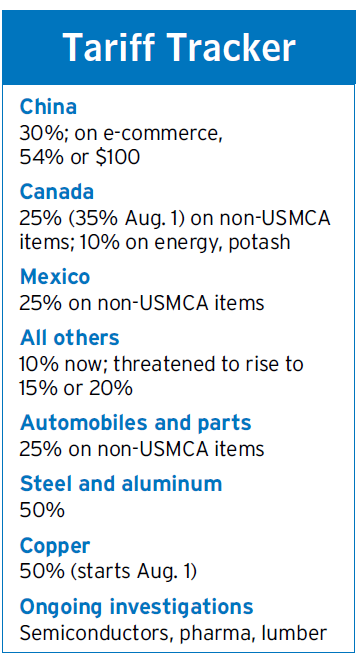
Proposed tariffs could raise $2.5 trillion but may shrink the U.S. economy and increase household costs by over $1,600 per year. Current tariffs are already pushing prices up. June inflation hit 2.7%, mainly due to costlier imported goods. Retailers are covering the extra costs for now, but that may not last.
At the same time, the job market is slowing. Fewer jobs are being created, wage growth is weaker, and fewer people are looking for work. Stricter immigration rules are also reducing the number of available workers, especially in industries like construction, farming, and services. These trends create uncertainty for both prices and the workforce in the months ahead.
|
|
|
📢 Important Notice for Pass-Through Entities
If your partnership, S corporation, or trust received Form 8986 due to an AAR filing or BBA audit, action is required by the deadline in Part II, Item F, often September 15, 2025. You must either:
✅ Pay your share of the adjustment or
🔁 Push out the adjustment to partners or beneficiaries.
Contact your account representative to discuss your options and stay compliant.
|
|
|
|
Tax-Smart Savings: ABLE & 529 Plan Updates
Big updates are coming for ABLE and 529 plans. Starting in 2025, ABLE accounts will allow up to $19,000 in contributions, with a possible extra for employed individuals. Funds can be used tax-free for disability-related expenses, and some may qualify for the Savers’ Credit.
In 2026, 529 plans will become more flexible. The K–12 withdrawal limit doubles to $20,000, and starting July 4, 2025, expenses like tutoring, books, exam fees, and therapies will qualify. Unused 529 funds can also be rolled over to ABLE accounts. And in 2027, donors can get a tax credit up to $1,700 for giving to approved K–12 scholarship programs.
|
|
|
Tax laws and financial rules are always changing, and we’re here to help you stay ahead. Follow SK Financial CPA on Facebook, Instagram, Twitter, LinkedIn and Youtube for real-time updates, smart tax tips, and guidance tailored to individuals and small business owners. We also share helpful reminders, important deadlines, and resources to make managing your finances easier. Don’t miss out, stay informed and empowered year-round.
|
|
|
|
|