|
Dear Client,
In this edition of the SK Financial CPA newsletter, we delve into the intricate details shaping the U.S. economy and tax landscape in 2024. From the staggering $546 billion annual cost of tax complexity to the widely varying gas tax rates across states, these insights highlight the financial challenges and opportunities that impact businesses and individuals alike. We also explore the fiscal risks of exempting Social Security benefits from income tax, the growing popularity of employer-offered educational assistance programs, and essential updates on tax relief for disaster victims. As always, our goal is to keep you informed and prepared to navigate the ever-evolving tax environment with confidence.
|
|
|
Tax Complexity Now Costs the U.S. Economy Over $546 Billion Annually
The U.S. tax code imposes significant costs on the economy, with direct costs including the $4.9 trillion in federal taxes, which equates to 17% of the nation's GDP. Indirect costs are also substantial, as Americans will spend an estimated 7.9 billion hours in 2024 to comply with tax filing and reporting requirements. This equates to about $413 billion in lost productivity, with an additional $133 billion spent on out-of-pocket compliance costs, bringing the total burden to $546 billion, or nearly 2% of GDP.
The IRS estimates that most of the compliance burden falls on businesses, with corporate income tax returns costing $119 billion. The complexity of tax regulations, especially for businesses, has only grown, despite technological advancements in tax preparation. Introducing new rules, such as those for cryptocurrency transactions, has increased compliance costs, adding 1.4 billion hours of paperwork. Overall, tax compliance represents a significant drag on economic productivity, illustrating the burden of navigating the U.S. tax system.
|
|
|
Reminder: If you filed a business tax extension, remember to submit your taxes by September 16th 2024. Don’t miss the deadline!
|
|
|
Exempting Social Security Benefits from Income Tax: A Risky Proposition
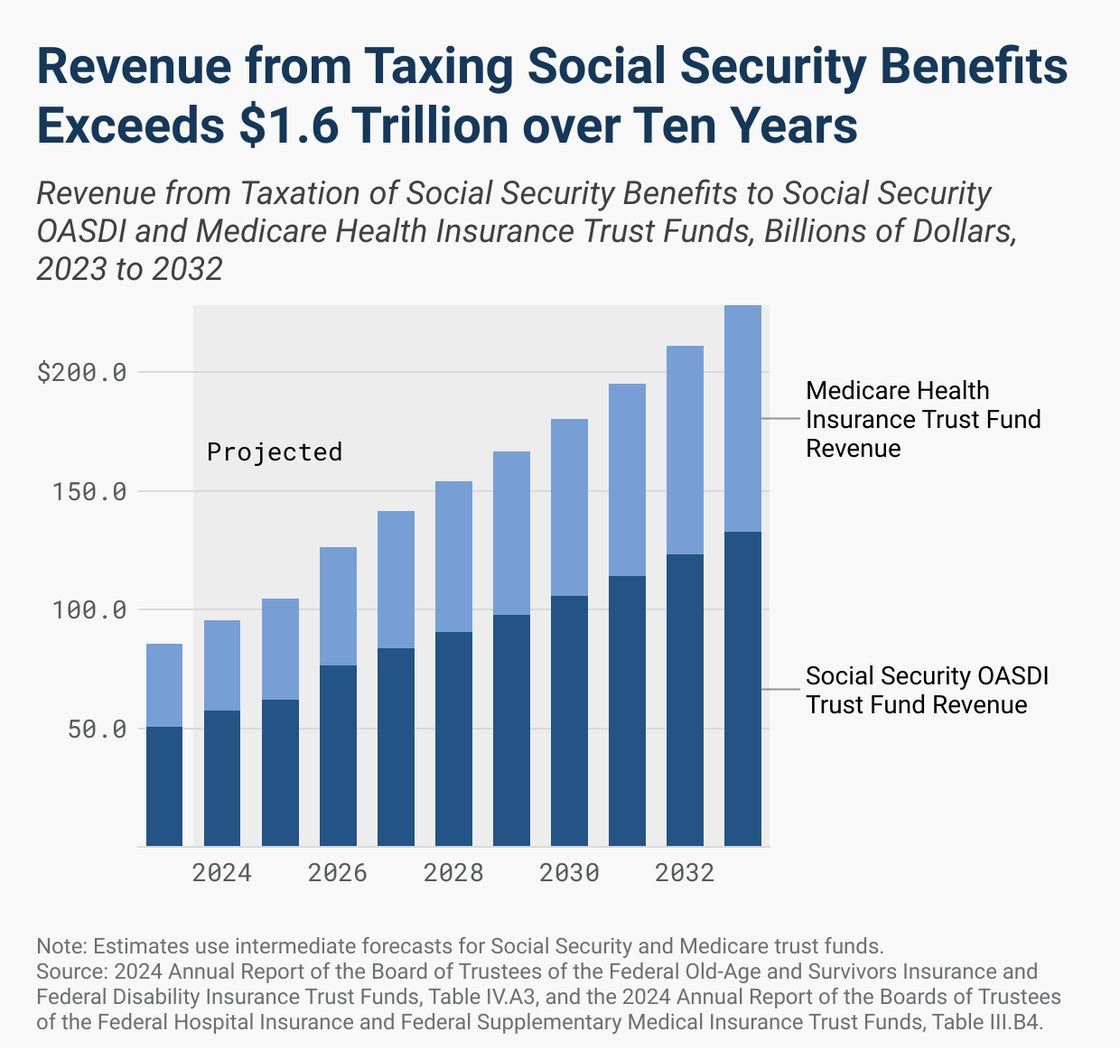
Former President Donald Trump and several lawmakers have recently advocated for exempting Social Security benefits from income tax, arguing it would ease financial pressure on retirees amid inflation. However, this policy could have severe fiscal consequences, including increasing the budget deficit by approximately $1.6 trillion over the next decade and hastening the insolvency of Social Security and Medicare trust funds. Currently, Social Security benefits are taxed based on a taxpayer's combined income, with revenue from these taxes directed to the Social Security and Medicare trust funds. Exempting benefits from income tax would significantly reduce this revenue, threatening the financial stability of these essential programs.
|
|
|
|
It could accelerate the insolvency of Social Security by two years and Medicare by six years, potentially leaving millions of Americans without critical benefits sooner than expected. While the proposal might slightly boost economic activity by encouraging work, savings, and investment, the overall impact on GDP and job creation would be minimal. Most of the tax benefits would go to higher earners, with the bottom 20% of taxpayers seeing no change. Despite a modest increase in after-tax incomes, the long-term fiscal risks make this policy unsound and fiscally irresponsible.
|
|
Gas Tax Rates Vary Widely Across States in 2024
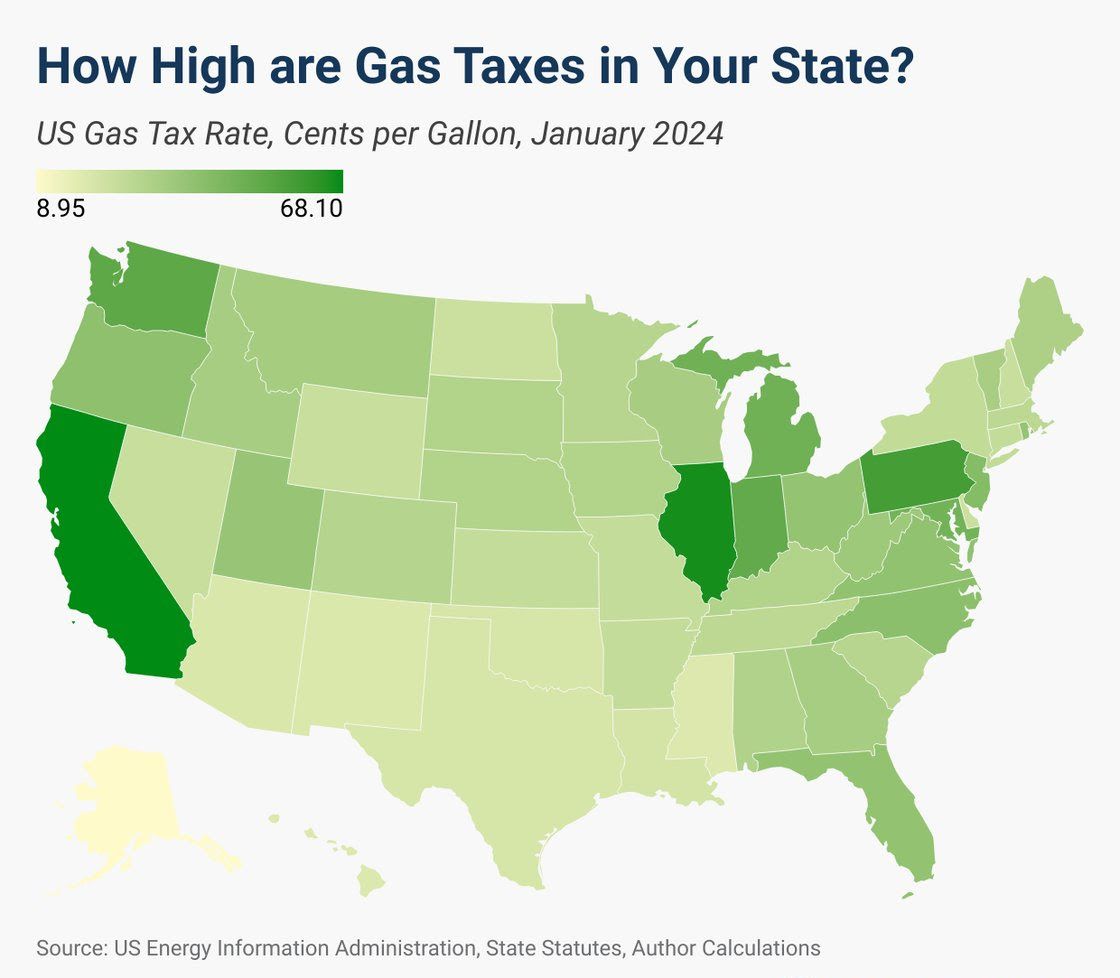
Gas taxes significantly impact the cost of driving for most Americans, with states imposing various taxes and fees on fuel, including excise taxes, sales taxes, and fees on wholesalers or retailers. In 2024, California leads with the highest gas tax at 68.1 cents per gallon, followed by Illinois at 66.5 cents and Pennsylvania at 58.7 cents. On the other end, Alaska has the lowest gas tax at 8.95 cents per gallon, with Mississippi and Hawaii also among the lowest. Traditionally, gas taxes function as user fees, funding road construction and maintenance. However, with the rise of electric vehicles and increased fuel efficiency, the effectiveness of gas taxes as user fees is declining. Some states are considering alternatives like vehicle miles traveled (VMT) taxes, which charge drivers based on the miles they drive rather than the gas they consume, aligning road usage costs more directly with road use.
|
|
|
In addition to traditional gas taxes, some states impose environmental taxes or participate in carbon-reduction programs, further increasing gas prices. California, for example, adds about 12 to 27 cents per gallon through its Low Carbon Fuel Standard and cap-and-trade program. These environmental taxes are designed to reduce emissions by making gasoline more expensive, though their impact on prices can vary. Overall, gas tax rates and additional environmental costs vary widely across the U.S., reflecting differing state priorities and policies.
|
|
Employer-Offered Educational Assistance Programs: A Way to Pay for College
Employer-offered educational assistance programs are a valuable resource for employees pursuing higher education. These programs, outlined in a formal written plan by the employer, can cover undergraduate or graduate-level educational expenses, including student loan debt, without being taxed. Educational assistance programs can be used to pay for a variety of educational costs, such as books, equipment, supplies, tuition, and other fees. Qualified education loans and loan payments are also covered, notably paying both the principal and interest on qualified education loans. This option is available only for payments made after March 27, 2020, and is set to continue under current law until December 31, 2025. Payments under these programs can be made directly to the lender or the employee, with tax-free benefits limited to $5,250 per employee per year. Any assistance provided above this amount is typically considered taxable income. These programs offer a tax-advantaged way to manage education-related expenses and can be a significant benefit for employees looking to advance their education and careers.
|
|
Review Education Tax Credits Before Filing
When filing taxes, taxpayers should be aware of two key education tax credits: the American Opportunity Tax Credit (AOTC) and the Lifetime Learning Credit (LLC). These credits can significantly reduce the cost of post-secondary education. To qualify for either of these credits in tax year 2024, the taxpayer, their spouse, or their dependents must have taken post-high school coursework. The student must possess a Form 1098-T, Tuition Statement, from an eligible educational institution, with some exceptions.
The AOTC offers a maximum benefit of up to $2,500 per eligible student and is available only for the first four years of college or vocational school, targeting students pursuing a degree or recognized educational credential. It is partially refundable, with up to $1,000 potentially returned to the taxpayer. On the other hand, the LLC provides a maximum benefit of up to $2,000 per tax return, regardless of the number of qualifying students. It is available for all years of postsecondary education, including courses to acquire or improve job skills, and can be claimed for an unlimited number of tax years. To claim these credits, taxpayers must complete Form 8863, Education Credits, and file it with their federal tax return. These credits can provide substantial savings, so it’s essential to understand their requirements and benefits before filing.
For more information:- How to Reduce Education Tax Credit in Tampa Florida
|
|
|
IRS Relief Available for Hurricane Debby Victims in Several States
The IRS has announced tax relief for individuals and businesses impacted by Hurricane Debby in South Carolina, Florida, North Carolina, and Georgia. This relief extends various federal tax filing and payment deadlines to February 3, 2025. Tax relief is available for anyone living or operating a business in areas designated by FEMA as disaster zones, including all counties in South Carolina, 61 counties in Florida, 55 counties in Georgia, and 66 counties in North Carolina. Affected taxpayers now have until February 3, 2025, to file returns and pay any taxes originally due during the relief period.
This applies to individuals and businesses with valid extensions to file their 2023 returns,
- Quarterly estimated income tax payments due on September 16, 2024, and January 15, 2025,
- Quarterly payroll and excise tax returns due on October 31, 2024, and January 31, 2025.
- Penalties for failing to make payroll and excise tax deposits will be abated for Florida deposits due from August 1, 2024, through August 16, 2024.
- South Carolina and Georgia deposits due from August 4, 2024, through August 19, 2024.
- North Carolina deposits due from August 5, 2024, through August 20, 2024.
Taxpayers in affected areas can claim unreimbursed disaster-related losses on their 2024 or 2023 tax returns, with up to six months after the 2024 tax return due date (October 15, 2025) to make this election. Qualified disaster relief payments for necessary expenses and repairs are excluded from gross income, and special disaster distributions from retirement plans may not be subject to the 10% early withdrawal tax and can be spread over three years. Hardship withdrawals may also be available.
|
|
|
Economic Overview: GDP Growth, Interest Rates, and Inflation Trends
|
|
|
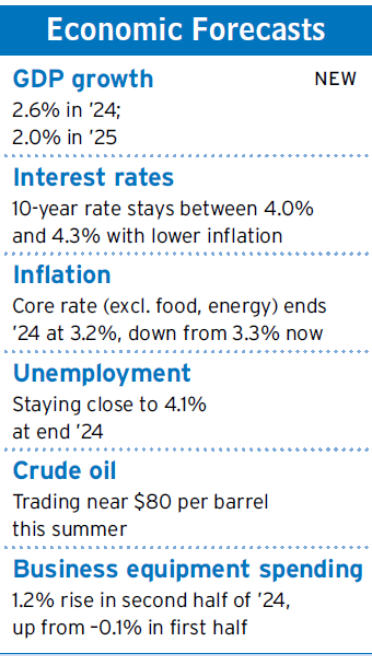
U.S. GDP is expected to grow by 2.6% in 2024 and slow to 2.0% in 2025. The 10-year Treasury rate is expected to stay between 4.0% and 4.3% as inflation eases. The core inflation rate is forecasted to end 2024 at 3.2%, slightly down from 3.3%. The national unemployment rate is anticipated to remain close to 4.1% by the end of 2024.
Financial Market Trends: Bond ETFs and Active ETFs Performance
There has been a significant influx of investments into actively managed bond ETFs, with record inflows of $41 billion in the first half of 2024. This trend is expected to continue as higher interest rates make bonds more attractive to investors. Active ETFs have seen strong performance this year, accounting for 30% of all ETF inflows. With continued market rallying, ETF inflows could reach an all-time high in 2024.
|
|
2025 Tax Cliff: What You Need to Know
As we approach the 2024 election, the stakes are high for the future of tax policy. Many provisions from the 2017 tax reform are set to expire after 2025 unless Congress acts. The next president and Congress will have the power to shape tax policy, potentially making the 2017 tax cuts permanent or introducing new changes. Donald Trump, if re-elected, has several tax proposals, including making the 2017 tax changes permanent, lowering tax rates further for individuals and businesses, proposing tax-free tips for hospitality and restaurant workers, dropping the corporate tax rate from 21% to 20% or possibly lower, eliminating clean-energy credits under the 2021 Inflation Reduction Act, and introducing a 10% tariff on imported goods. Additionally, a conservative policy blueprint, "Project 2025," outlines potential future tax changes, such as two individual income tax rates of 15% and 30%, an 18% corporate tax rate, a 15% capital gains tax rate with inflation indexing, and the elimination of many deductions, including the state and local tax deduction.
Adoption Tax Credit
For those adopting or planning to adopt a child, the adoption tax credit is available for up to $16,810 of qualified expenses in 2024. This credit can be claimed for domestic and international adoptions, though the timing of when you can claim the credit differs between the two.
Deducting Rental Losses
Rental real estate owners should be aware of the rules around deducting rental losses. There are exceptions for real estate professionals and those actively participating in rental activities, but there are also limits based on income and other factors. The IRS closely monitors returns with large rental losses, so ensure your claims are accurate.
Digital Assets and Tax Reporting
The IRS has finalized regulations on broker tax reporting rules for digital assets. Starting with sales occurring after 2024, brokers will report digital asset transactions on new Form 1099-DA, with additional reporting requirements phased in over the next few years.
|
|
|
Client Success Story: Resolving a $77,360 Penalty and Interest Issue
A client recently faced a substantial tax issue for the 2022 tax year. After we filed their Georgia state tax return, the client was unexpectedly penalized $50,000, charged interest of $27,360, and notified of an additional tax owed amount of $200,000. This was surprising, as the client had made an estimated tax payment of $1.2 million, confirmed by the Georgia Department of Revenue in November 2023.
Upon investigation, we discovered two errors on the part of the Georgia Department of Revenue:
-
Incorrect Information Provided: The department had initially confirmed the estimated tax payment as $1.2 million, but it was later revealed that the correct amount was $1 million.
-
Misapplication of Refund: The client’s expected refund for 2023 had been applied to the following year, 2023. However, during their review of the return, the Georgia Department of Revenue moved the refund first, used it for the next year, and then deducted the tax owed for 2022. This created a discrepancy of $200,000.
We promptly contacted the Georgia Department of Revenue, requesting them to correct these errors by moving the $200,000 back from 2023 to 2022. Additionally, we successfully argued to remove the penalties and interest, as the client had made all payments on time, and the issues were due to department errors.
As a result of our effective communication and diligent efforts, the Georgia Department of Revenue removed the $50,000 penalty, and the $27,360 in interest, and zeroed out the client’s account. The matter was successfully resolved, ensuring our client faced no further financial burden.
|
|
|
Heavy Highway Vehicle Use Tax Deadline Approaching
SK Financial reminds truckers and bus operators that the deadline for filing Form 2290, Heavy Highway Vehicle Use Tax Return, is Tuesday, September 3, 2024. This tax applies to vehicles with a gross weight of 55,000 pounds or more used on public highways. The deadline typically falls on August 31 but is extended due to the date landing on a Saturday this year. E-filing is encouraged for all, and mandatory for those with 25 or more vehicles. Ensure you gather all necessary information, such as Vehicle Identification Numbers (VINs) and Employer Identification Numbers (EINs), to make the process smooth and efficient.
|
|
|
IRS, States, and Tax Industry Launch New Joint Effort to Combat Tax Scams
The IRS, along with state tax agencies and key members of the tax industry, has announced the formation of the Coalition Against Scam and Scheme Threats (CASST). This initiative aims to combat the rise in scams and schemes targeting taxpayers and tax systems. Building on the success of the Security Summit's efforts to curb tax-related identity theft, CASST will focus on expanding outreach, identifying fraudulent tax returns, and improving infrastructure to protect taxpayers. The coalition, supported by over 60 private sector groups, plans to implement new protections by the 2025 tax season.
Child and Dependent Care Tax Credit Can Offset Summer Day Camp Expenses
SK Financial reminds taxpayers that summer day camp expenses may be eligible for the Child and Dependent Care Tax Credit. This credit helps working parents who pay for the care of children under 13 years old, allowing them to work, look for work, or attend school. Unlike overnight camps, the cost of day camps can be counted towards this credit. Depending on income, taxpayers can claim a credit of 20% to 35% of qualifying childcare expenses. For 2024, the maximum eligible expense is $3,000 for one qualifying person and $6,000 for two or more. To claim the credit, taxpayers must include the day camp's name, address, and taxpayer identification number on their return.
|
|
|
Tax Relief Available for Disaster Victims in Minnesota and Vermont
The IRS has extended the deadline for disaster-area taxpayers in Minnesota and Vermont to file various federal individual and business tax returns and make required payments until February 3, 2025. This relief is available to all areas designated by FEMA, with additional counties possibly being included later. The updated list of eligible localities can be found on the IRS's "Tax relief in disaster situations.
|
|
|
|
|
|