|
Dear Client,
Welcome to the midyear 2024 edition of the SK Financial CPA newsletter. In this issue, we delve into the critical role of state and local sales taxes, highlight the IRS's latest relief measures for Mississippi storm victims, and analyze Donald Trump's proposed tax and tariff policies. We also cover significant developments, including the IRS's collection of past-due taxes from high-wealth groups, new cryptocurrency tax reporting rules, and warnings against misleading tax credit claims. Stay updated on economic forecasts, inflation trends, and changes in tax regulations that could impact your financial planning and business operations.
|
|
|
State and Local Sales Tax Rates Overview, Midyear 2024
State and local sales taxes are a crucial revenue source for most states in the United States. Here's a detailed look at the current landscape and its implications:
Importance of Sales Taxes
Sales taxes are a significant revenue tool for state and local governments. They make up about a quarter of the combined tax revenues for these entities. Unlike individual income taxes, sales taxes tend to cause fewer economic distortions. This means they are less likely to interfere with economic growth, making them a more pro-growth tax option.
Geographic Coverage
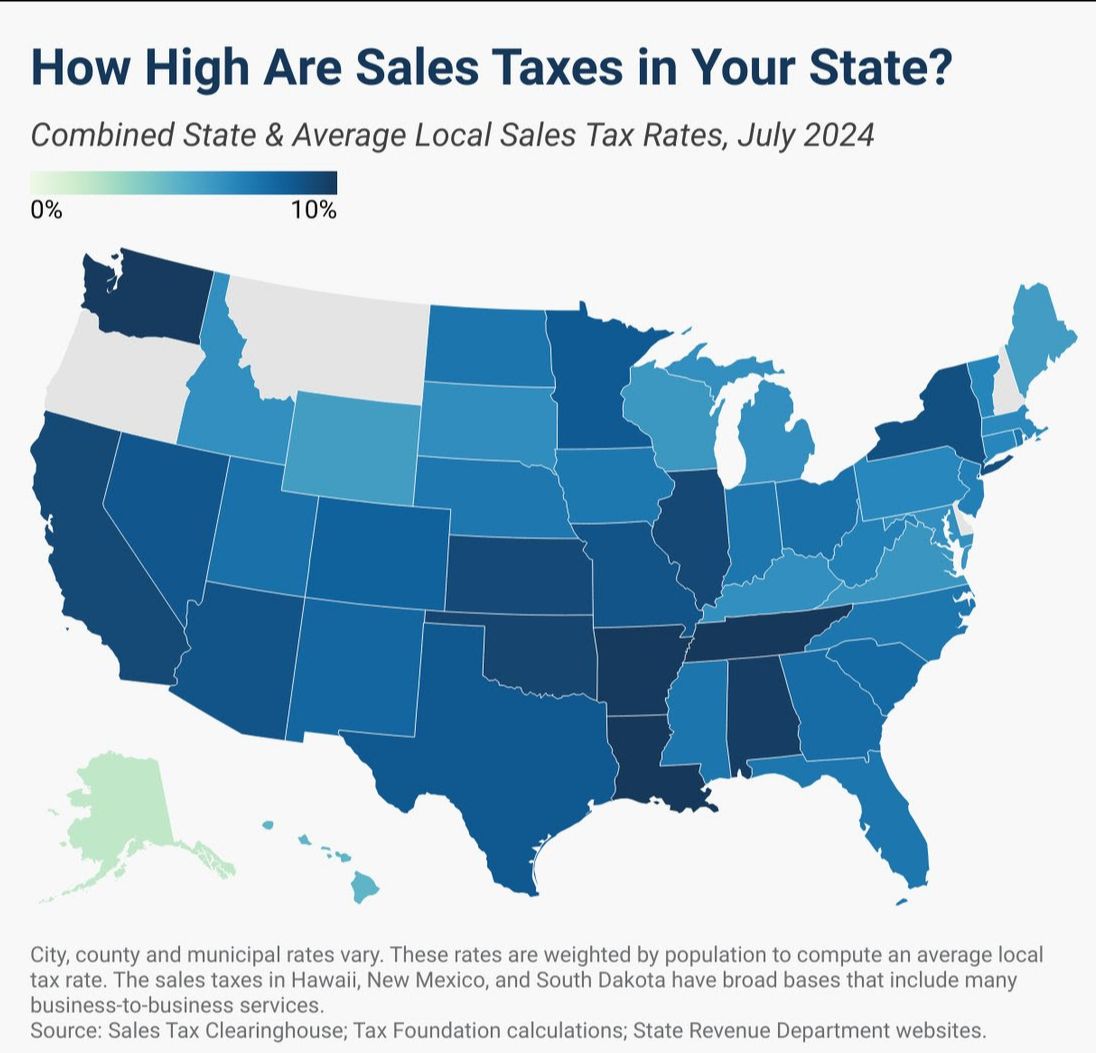
Forty-five states in the U.S. impose state-level sales taxes. In addition to these state taxes, 38 states have local sales taxes. In some cases, these local taxes can be higher than the state taxes, adding an extra layer to what consumers pay at the register.
States with Highest Combined Rates
Some states have notably high combined state and local sales tax rates. Louisiana tops the list with a combined rate of 9.565%. Tennessee is close behind at 9.556%, followed by Arkansas at 9.47%, Washington at 9.45%, and Alabama at 9.29%. These high rates can significantly impact consumer spending and business operations in these states.
Considerations and Impacts
The differences in sales tax rates between states can lead to cross-border shopping, where consumers travel to neighboring states with lower taxes to make purchases. This can also drive more online shopping, where tax rates might be lower or even absent. The variations in what is taxed (the tax base) can also influence how much revenue is collected and the overall economic impact. For instance, Tennessee has high sales taxes but no income tax, while Oregon has no sales tax but higher income taxes. These differences can shape consumer behavior and economic decisions within each state.
Policy and Economic Effects
Sales taxes are a policy tool that lawmakers can adjust relatively quickly, which means changes can have an immediate impact on consumer spending and business decisions. While many factors influence where businesses choose to locate and invest, sales tax policies are a significant factor because they affect the immediate cost of goods and services. Given their direct impact on consumer behavior and economic vitality, sales taxes should be carefully considered in broader tax policy decisions.
|
|
|
Sales Tax Snapshot 2024
|
|
|
IRS Announces Tax Relief for Mississippi Storm and Flood Victims
The IRS has introduced tax relief measures for individuals and businesses in Mississippi affected by severe storms, straight-line winds, tornadoes, and flooding beginning April 8, 2024. Taxpayers residing or operating businesses in designated disaster areas, including Hancock, Hinds, Humphreys, Madison, Neshoba, and Scott counties, now have until November 1, 2024, to file various federal tax returns and make payments originally due between April and November 2024. This includes income tax filings, IRA contributions, and quarterly estimated payments. Additionally, penalties for certain tax deposits will be waived.
|
|
|
|
Analysis of Trump's Tax and Tariff Ideas
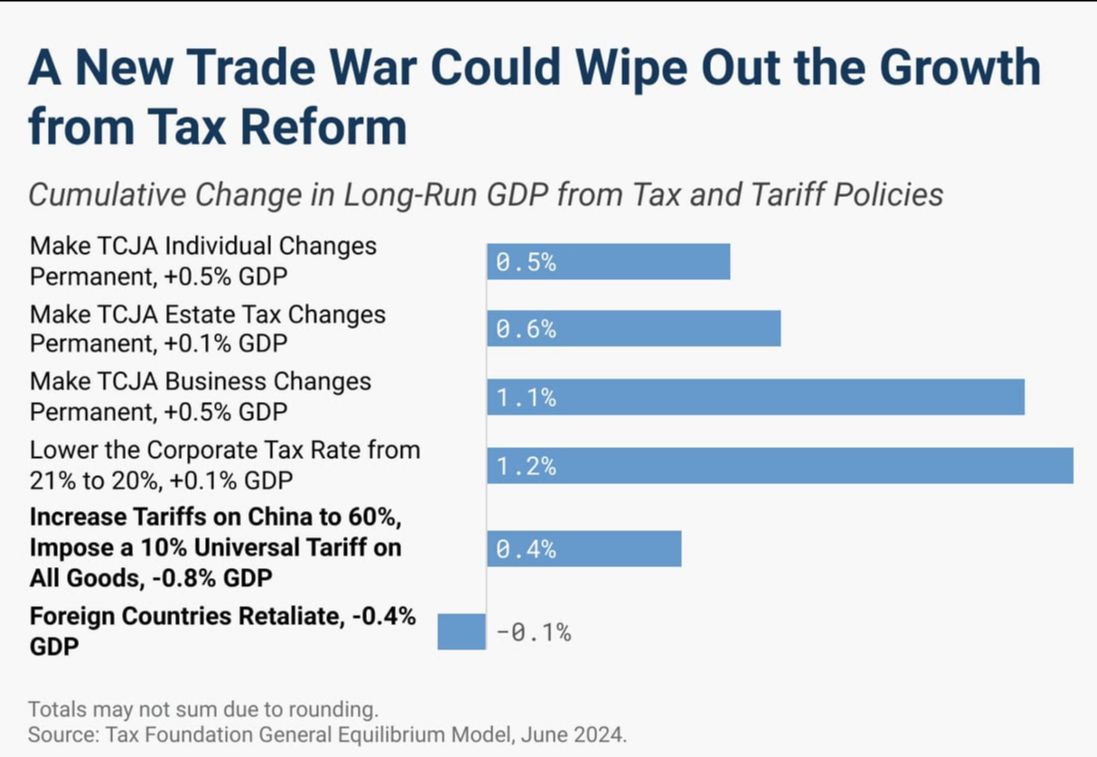
As the Republican National Convention nears, Donald Trump has outlined key tax policy proposals, including the extension of the 2017 Tax Cuts and Jobs Act (TCJA) provisions for individuals and businesses. This includes maintaining reduced tax rates and other incentives. He also proposes further reducing the corporate income tax rate to boost competitiveness and corporate investment. Additionally, Trump suggests implementing a universal baseline tariff of at least 10% on all imports, with a substantial increase in Chinese imports to 60% or more to protect domestic industries.
Economic Impact Analysis
Extending the TCJA and reducing corporate taxes could potentially increase long-run GDP by 1.2% and add nearly 1 million full-time jobs. However, the resulting tax cuts may reduce federal revenue by $4.3 trillion over the next decade, worsening the deficit. The proposed tariffs could reduce long-run GDP by 0.8% and lead to the loss of approximately 684,000 full-time jobs. If retaliatory tariffs are imposed by trading partners, the economic benefits of the tax cuts could be negated, leading to a net loss for the US economy. Policymakers and economists continue to debate the effectiveness and trade-offs of these proposals.
|
|
|
IRS Collects $1 Billion in Past Due Taxes from High-Wealth Groups
The IRS announced the collection of over $1 billion in overdue taxes from high-wealth groups, corporations, and partnerships as part of compliance efforts under the Inflation Reduction Act. This collection activity, focusing on high-income individual taxpayer cases, marks a significant milestone in the IRS's efforts to ensure tax compliance and fairness. The initiative targets taxpayers with more than $1 million in income and over $250,000 in recognized tax debt.
|
|
|
New Cryptocurrency Tax Reporting Rules Finalized
The administration has introduced new tax reporting regulations aimed at improving compliance and transparency within the cryptocurrency market. Starting in 2026, cryptocurrency exchanges and payment processors like Coinbase and Kraken must report detailed transaction information to the IRS, specifically for custodial platforms.
Investors will receive a new Form 1099-DA annually, similar to forms provided by banks and brokers, to facilitate easier and more accurate tax reporting. This measure aims to deter tax evasion and ensure proper compliance, addressing the inaccuracies and issues arising from previous reliance on unregulated service providers. Investors should consult with their tax advisors to understand the implications of these changes.
|
|
|
|
IRS Warns Against Misleading Tax Credit Claims
The IRS has issued a warning about misleading information on social media regarding a fictitious "Self Employment Tax Credit." Promoters falsely claim that self-employed individuals and gig workers can receive large payments of up to $32,000 for the COVID-19 pandemic period, which is inaccurate. The actual credits related to COVID-19 are the Credits for Sick Leave and Family Leave, with specific eligibility criteria applicable only for 2020 and 2021, not 2023. SK Financial CPA advises its clients to consult their tax preparer before taking any decision or steps to avoid penalties or denial of claims, as well as warns against other scams such as Fuel Tax Credit and household employment taxes.
Treasury and IRS Issue Final Regulations on Corporate Stock Repurchase Excise Tax
The Department of the Treasury and the IRS have released final regulations detailing how corporations should report and pay a new 1 percent excise tax on stock repurchases, introduced under the Inflation Reduction Act. Effective for repurchases after December 31, 2022, the excise tax applies to the aggregate fair market value of repurchased stock by certain domestic and foreign corporations. Corporations are required to report this tax on Form 720, Quarterly Federal Excise Tax Return, due for the first full calendar quarter after the end of their taxable year. Attached to Form 720, Form 7208, Excise Tax on Repurchase of Corporate Stock, calculates the tax owed. For taxable years ending between December 31, 2022, and June 30, 2024, both forms are due by October 31, 2024. These regulations primarily impact publicly traded corporations and affiliates subject to the new stock repurchase rules.
Qualified Business Income (QBI) Deduction for Rental Properties
Owners of rental properties, including LLCs, partnerships, and S corporations, may qualify for a 20% deduction on their QBI until 2025, subject to income thresholds and activity criteria. It's essential to meet IRS guidelines, either by treating rentals as a trade or business or by meeting safe harbor requirements involving minimum hours spent on property management.
|
|
|
First-Time Abatement Policy for Late Filing and Payment Penalties
Taxpayers who file delinquent returns or pay taxes late may qualify for a penalty waiver under the IRS's first-time abatement policy. This waiver is available for late filing and payment penalties for those compliant over the past three years but does not cover estimated tax penalties.
|
|
|
|
Simplified Requirements for R&D Credit Refund Claims
The IRS has eased requirements for R&D credit refund claims, no longer necessitating the names of researchers or detailed discovery information. This simplification applies to claims filed after June 17, 2024. The IRS is also revising Form 6765 to reflect these changes.
Slow Processing of Employee Retention Credit Refund Claims
The IRS is slowly processing employee retention credit (ERC) refund claims, prioritizing those filed before September 14, 2023. Many claims have potential errors, and the IRS has paused processing for later-filed claims.
|
|
|
IRS Warns of New Scam Targeting Clean Energy Tax Credit
The IRS has issued a warning about a new scam where unscrupulous tax return preparers misrepresent the rules for claiming clean energy tax credits under the Inflation Reduction Act (IRA). This scam involves preparers claiming purchased clean energy credits on returns, which the taxpayers are ultimately unable to benefit from. It mainly targets individuals filing Form 1040, leading them to improperly claim credits that offset income tax from wages, Social Security, and retirement withdrawals. The IRS cautions that such credits are subject to passive activity rules and can generally only offset income tax from passive activities, which most taxpayers do not have. SK Financial CPA advises clients to consult with their Account Representatives or tax preparer before making any decisions, as inappropriate claims could lead to repayment, interest, and penalties.
|
|
|
|
Economic Forecasts and Trends
|
|
|
Inflation Update
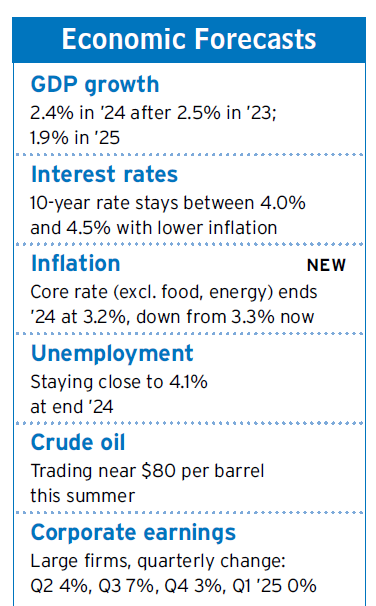
The Consumer Price Index (CPI) rose by 3% in June, slightly down from May’s 3.3%, indicating that inflationary pressures are beginning to ease. However, this decline is not sufficient for the Federal Reserve to cut interest rates immediately. A potential rate cut could occur in September, though it remains close to the upcoming election. The headline inflation rate is expected to remain above 3% until sometime in 2025, offering little relief to consumers still feeling the effects of recent price spikes.
Economic Indicators
The June jobs report showed an addition of 206,000 new jobs, which, while decent, is not spectacular. Significant downward revisions to the job numbers for April and May indicate a softer labor market than previously thought. Average pay rose by 3.9% in June, a robust increase, but slower than recent trends, which should aid in gradual disinflation.
|
|
|
|
|