|
Dear Client,
At SK Financial CPA, we believe staying informed is the key to making smart financial decisions. In this edition, we bring you the latest tax updates, expert insights, and essential deadlines to help you stay ahead. Whether you're a business owner or an individual taxpayer, our goal is to simplify complex financial matters so you can focus on what matters most.
2024 Tax Filing Deadlines
| Deadline |
Description |
| April 15, 2025 |
Standard tax filing deadline for most taxpayers. |
| May 1, 2025 |
Extended deadline for taxpayers in Alabama, Florida, Georgia, North Carolina, South Carolina, and parts of Alaska, New Mexico, Tennessee, Virginia, and West Virginia due to disaster relief. |
| October 15, 2025 |
Extended deadline for Southern California wildfire victims. |
| November 3, 2025 |
Extended deadline for Kentucky flood victims. |
| Extension Requests |
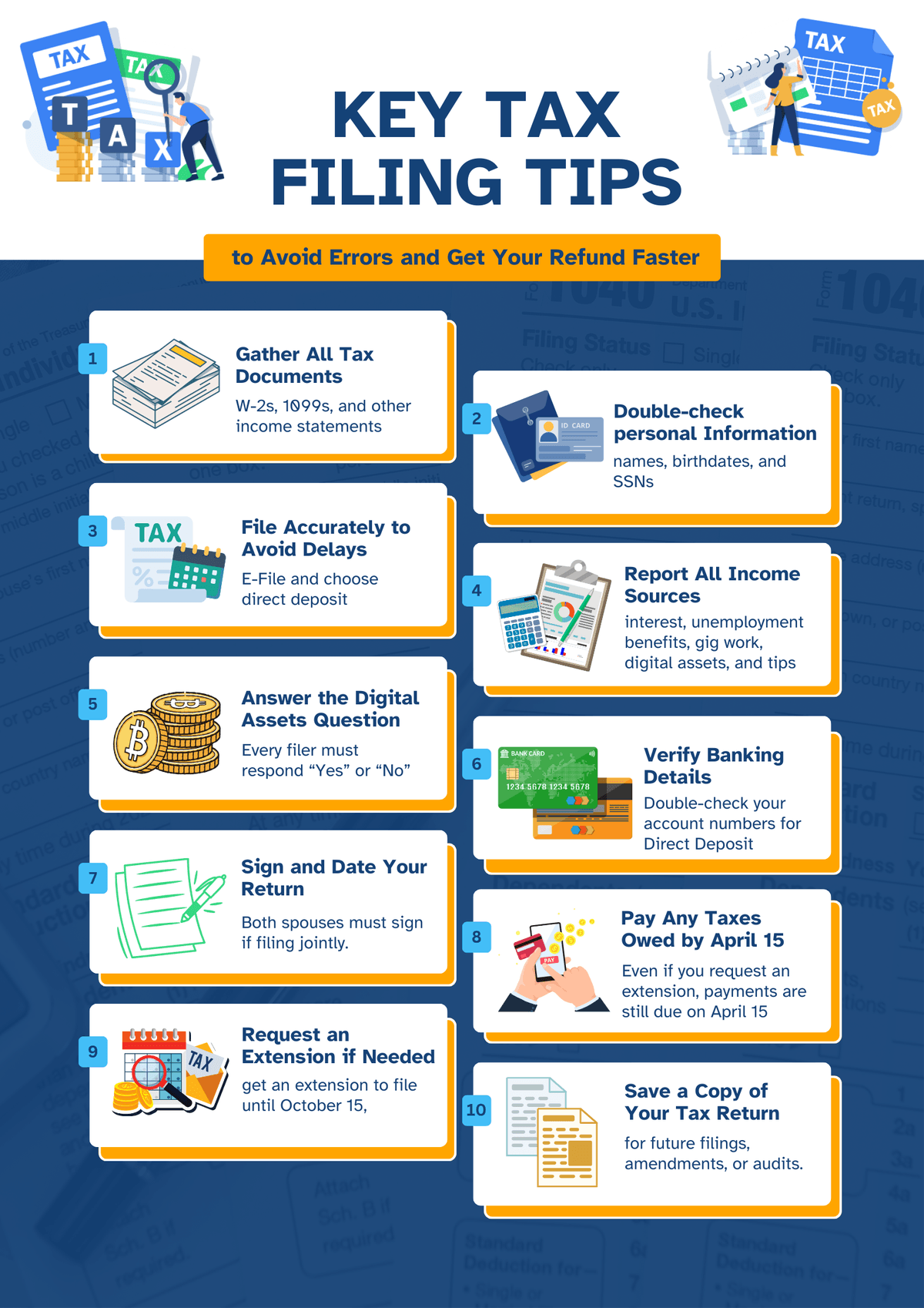
Taxpayers needing more time can request an extension until October 15, 2025. Note that this extension applies only to filing; any taxes owed must still be paid by the original deadline to avoid penalties and interest. |
Note: While extensions provide additional time to file your tax return, any taxes owed are still due by the original deadline to avoid penalties and interest. If you require an extension, please inform your SK Financial CPA preparer promptly to ensure proper filing.
|
|
|
Republicans Push for Key Business Tax Breaks
Republicans are negotiating a tax package that includes extending the 20% Qualified Business Income (QBI) deduction, which benefits self-employed individuals, contractors, landlords, and small business owners. Originally introduced in 2017, this deduction is set to expire after 2025, but lawmakers want to make it permanent despite its high cost. Additionally, lawmakers aim to restore three major business tax breaks:
- Bonus Depreciation: Businesses could once deduct 100% of new equipment costs, but this has dropped to 40% in 2024 and will fall to 20% in 2025 unless reversed.
- R&D Expenses: Previously, companies could deduct research and development costs in the same year, but now, these deductions are spread over five years (or 15 years for overseas research). Lawmakers want to return to the old system.
- Interest Deductions: Since 2022, stricter rules have limited how much interest big companies can deduct. Lawmakers want to loosen these restrictions.
2025 Tax Breaks for Business Vehicles
Business owners can benefit from substantial tax deductions on vehicles in 2025. The first-year depreciation cap for standard cars is $20,200 with bonus depreciation, followed by $19,600 in the second year, $11,800 in the third, and $7,060 for subsequent years. Without bonus depreciation, the first-year cap drops to $12,200.
Heavy vehicles (over 6,000 lbs) receive even larger deductions. SUVs can cost up to $31,300, with 40% of the remaining cost eligible for bonus depreciation and the rest depreciable over five years. Pickup trucks with a six-foot cargo bed may qualify for full expensing based on business use. Business owners should note that total expensing cannot exceed taxable business income, but bonus depreciation remains an option without this restriction, making it a valuable tax strategy.
Tax Rules for Leasing a Business Vehicle
Businesses leasing a vehicle worth over $62,000 in 2025 must account for an often-overlooked tax rule. The IRS requires lessees to report additional taxable income each year of the lease, as outlined in IRS tables (Rev. Proc. 2025-16). This rule offsets the tax advantage of leasing by mimicking the depreciation cap on purchased vehicles. Instead of reporting the income separately, businesses must reduce the deductible lease payments accordingly.
Proposed Increase in Business Start-Up Cost Deduction
Businesses can deduct up to $5,000 in start-up costs in their first year, with the remaining costs amortized over 180 months. Expenses incurred before the business starts must be capitalized. A House GOP bill proposes increasing this deduction to $20,000, but it remains uncertain if this provision will be included in the final tax package.
|
|
|
Federal Income Tax Will Stay
Despite some Republican lawmakers and former President Trump advocating for replacing federal income tax with a consumption-based tax, eliminating income tax is not being considered in current tax discussions. The primary focus is on extending expiring tax breaks rather than abolishing income taxes, which have existed since 1913.
IRS Clarifies Tax Rules for Paid Family and Medical Leave
The IRS has issued new guidance on the tax treatment of state-mandated paid family and medical leave programs, which are currently required in 13 states and Washington, D.C. Employers can deduct their contributions as excise tax payments, while employee contributions are considered taxable wages. However, employer contributions are not included in employees' federal taxable income. Employees may deduct their contributions as state income taxes on Schedule A if they itemize, but they must stay within the $10,000 state and local tax deduction limit. Additionally, family leave benefits received from the state are taxable and must be reported on Form 1099. The tax treatment of medical leave benefits is more complex, as outlined in IRS Rev. Rul. 2025-4.
New 401(k) and Retirement Rule Changes Coming in 2026
Starting in 2026, high earners will face new rules for 401(k) catch-up contributions. While employees aged 50+ can currently contribute to traditional or Roth 401(k)s, those earning over $145,000 will be required to put all catch-up contributions into Roth 401(k)s, removing immediate tax savings. The IRS has provided guidance to employers on implementing these changes. Additionally, the SECURE 2.0 Act will expand ABLE accounts by increasing the age limit for eligibility from 26 to 46 and allow penalty-free 401(k) withdrawals of up to $2,500 per year for long-term care insurance premiums. These changes will affect retirement savings and tax planning strategies for many workers.
|
|
|
Unclaimed 2021 Tax Refunds Deadline: April 15, 2025
Over 1.1 million taxpayers have yet to file their 2021 tax returns, putting their refunds at risk. The IRS estimates that more than $1 billion in refunds remain unclaimed, with a median refund amount of $781. Taxpayers have until April 15, 2025, to file their 2021 return and claim their money. After this deadline, any unclaimed refunds will become the property of the U.S. Treasury and can no longer be recovered.
|
|
|
|
Gift Tax Exclusion for 2025: Important Updates
In 2025, the annual gift tax exclusion increases to $19,000 per recipient, allowing individuals to give this amount to as many people as they want without incurring a gift tax or filing a gift tax return. Couples can jointly give up to $38,000 per recipient by electing gift splitting, which requires filing Form 709 but does not trigger tax. Gifts exceeding $19,000 per recipient must also be reported on Form 709, though the gift tax only applies if the $13.99 million lifetime exemption has been exhausted. For estate planning, leveraging tax-free gifts now can help maximize wealth transfers.
Foreign Earned Income Exclusion—2025 Housing Expense Adjustments & 2024 Waiver Countries
The IRS has announced that for the 2025 tax year, the maximum Foreign Earned Income Exclusion (FEIE) is $130,000, an increase from $126,500 in 2024. Consequently, the base housing amount is set at $20,800 (16% of the FEIE), and the standard housing expense limitation is $39,000 (30% of the FEIE). These housing limits may be adjusted for specific locations with higher housing costs. Additionally, for the 2024 tax year, the IRS has added Ukraine, Iraq, Haiti, and Bangladesh to the list of waiver countries, allowing eligible individuals in these regions to claim the FEIE even if they do not meet the standard time requirements due to adverse conditions.
Claiming the Earned Income Tax Credit? Know the Rules and Audit Risks
The Earned Income Tax Credit (EITC) is a frequent IRS audit trigger, often due to errors in claiming a qualifying child. To qualify:
-
The child must be a son, daughter, stepchild, foster child, sibling, niece, nephew, or grandchild who lived with you for more than half the year and is under age 19.
-
Exceptions: Full-time students qualify until age 24, and those permanently and disabled have no age limit.
-
Each qualifying child must have a valid Social Security Number (SSN).
Most EITC audits occur through mail correspondence, with the IRS requesting additional documentation rather than conducting in-person audits.
IRS Cracks Down on Worker Misclassification
The IRS is intensifying efforts to address worker misclassification, where businesses incorrectly label employees as independent contractors to avoid payroll taxes. To determine proper worker status, the IRS assesses behavioral control, financial control, and the nature of the relationship. Businesses may qualify for Section 530 relief from federal employment tax liabilities if they meet specific criteria. Recent IRS guidance, Revenue Procedure 2025-10, clarifies the application of Section 530 relief and outlines how businesses can meet the reasonable basis requirement.
|
|
|
IRS Reminder: April 1, 2025, RMD Deadline for Retirees
Individuals who turned 73 in 2024 must take their first Required Minimum Distribution (RMD) from retirement accounts like traditional IRAs and 401(k)s by April 1, 2025. Subsequent RMDs are due annually by December 31, with the second RMD for 2025 also due by December 31, 2025. Roth IRAs are exempt from RMDs during the account owner's lifetime. Failure to comply can result in penalties.
|
|
|
|
Tax Breaks for U.S. Citizens Working Abroad
U.S. citizens working abroad in 2025 can exclude up to $130,000 of foreign-earned income from U.S. taxation. Eligibility requires either full-year bona fide residency in another country or physical presence abroad for at least 330 days within a 12-month period. A foreign tax home is also necessary, except for those in combat zones. To claim this exclusion, taxpayers must file Form 2555 with their U.S. tax return. Additionally, a standard foreign housing exclusion of $18,200 is available for 2025, with potential increases for high-cost areas as specified in IRS Notice 2025-16.
The Economic Impact of Trade Policy Shifts and Tariffs
In March 2025, the United States implemented significant tariff measures affecting key trade partners. Effective March 4, a 25% tariff was imposed on all imports from Canada and Mexico, with Canadian energy resources such as oil, natural gas, and electricity subject to a reduced 10% tariff. On March 12, a universal 25% tariff on steel and aluminum imports from all countries took effect.
Further escalating trade tensions, on March 24, President Trump announced that starting April 2, a 25% tariff would be applied to all goods imported from countries that continue to purchase oil from Venezuela. These actions have prompted retaliatory measures from affected nations, including Canada, China, and the European Union, leading to increased global trade tensions and economic uncertainty.
IRS Interest Rates for the Second Quarter of 2025
Effective April 1, 2025, the IRS has set the second quarter interest rates as follows: individuals will have a 7% rate for both overpayments and underpayments, compounded daily; corporations will have a 6% rate for overpayments, 4.5% for overpayments exceeding $10,000, 7% for underpayments, and 9% for large corporate underpayments.
ABLE Savings Accounts and Tax Benefits for Persons with Disabilities
ABLE accounts are tax-advantaged savings accounts for individuals with disabilities, allowing contributions up to $19,000 in 2025 without affecting eligibility for federal assistance programs like SSI or Medicaid. Employed beneficiaries may contribute additional amounts up to the lesser of their compensation or $15,650 in the continental U.S., $19,550 in Alaska, or $17,990 in Hawaii. While contributions are not federally tax-deductible, earnings and withdrawals are tax-free when used for qualified disability expenses. Eligible contributors may also benefit from the Saver's Credit, a non-refundable tax credit of up to $1,000 ($2,000 if married filing jointly), depending on income and filing status.
|
|
- Refer a new client and unlock rewards worth $210 to $1,350. Choose between cash or exclusive discounts on our Bookkeeping services.
- You will receive a discount or cash on our bookkeeping services once the client stays with us for 3 months
- Earn $50 by referring a friend or family member! Once they become our client, you’ll receive $50 for our Tax services.
- You, your friends, and your colleagues can all earn extra cash with this referral program.
|
|
|
|
Tax season is in full swing, and we want to ensure you’re fully prepared. At SK Financial CPA, we’re committed to keeping you informed about key deadlines, tax law changes, and strategies to help you maximize savings and stay compliant. Whether you're filing for yourself or your business, our expert guidance will make the process seamless and stress-free.
If you have any questions or need personalized tax assistance, don’t hesitate to reach out. Our team is always here to help! Follow us on social media for real-time updates, expert insights, and important financial news.
|
|
|
|
|