|
IRS Announces Lower Interest Rates for Early 2025
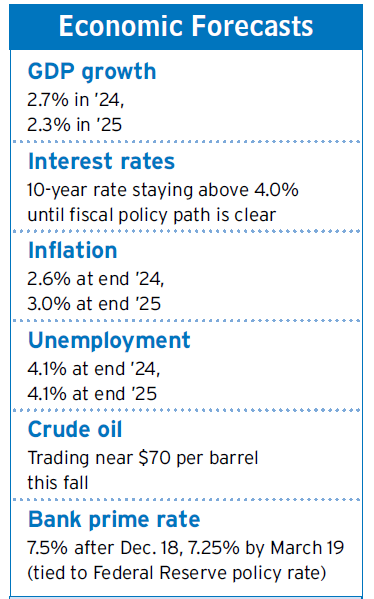
The IRS has revealed that interest rates will decrease starting January 1, 2025, for the first quarter. For individuals, the annual interest rate for tax overpayments and underpayments will be 7%, compounded daily. Corporate overpayments will be subject to a 6% rate, reduced to 5% for amounts exceeding $10,000. Significant corporate underpayments will face a 9% rate. These rates are based on the federal short-term rate from October 2024, with adjustments. For individual rates, the IRS adds three percentage points to the federal rate, while corporate rates vary depending on specific circumstances, such as a five-percentage-point increase for large underpayments. Further details can be found in Revenue Ruling 2024-25.
Fraud Prevention During International Fraud Awareness Week
The IRS has partnered with the Office of Fraud Enforcement and IRS Criminal Investigation to highlight tax fraud reporting during International Fraud Awareness Week (November 17–23). Taxpayers are encouraged to recognize and report scams or fraudulent schemes. Violations can be reported using specific forms:
-
Form 3949-A (Information Report Referral): For reporting tax law violations like unreported income, false deductions, or tax evasion.
-
Form 13909: For concerns about misuse or noncompliance by tax-exempt organizations.
-
Form 14242: To report abusive tax schemes, promoters, or preparers, which may result in penalties, injunctions, or criminal actions.
The IRS incentivizes whistleblowers through Form 211 (Application for Award of Original Information), enabling individuals to earn monetary rewards for credible fraud evidence. Additionally, the IRS regularly updates its Dirty Dozen list of common scams, such as phishing, fake charities, and improper tax credit claims, urging vigilance among taxpayers.
National Tax Security Awareness Week
The IRS has raised awareness about increased scams during the holiday season, including phishing emails, identity theft, and fraudulent delivery messages. Notable threats include fake IRS emails that promise refunds or demand immediate payments. To avoid falling victim, taxpayers should take the following precautions:
-
Shop only on secure websites starting with “https.”
-
Avoid public Wi-Fi for financial transactions.
-
Update security software and use strong, unique passwords.
-
Enable multi-factor authentication for added protection.
Visit IRS Identity Theft Central for more resources and guidance on protecting personal and financial information.
Year-End Tax Planning
With 2024 drawing to a close, taxpayers are encouraged to review key deadlines and strategies for maximizing tax benefits. For Flexible Spending Arrangements (FSAs), the contribution limit for 2025 is set at $3,300 per employee, with a maximum household contribution of $6,600 if both spouses participate. Additionally, FSAs allow a carryover of up to $660 for unused funds, depending on employer policies.
Charitable giving can also play a significant role in year-end planning. By consolidating multiple years’ worth of donations into 2024, taxpayers can increase deductions. Donor-Advised Funds (DAFs) offer a flexible solution, providing an immediate tax deduction while allowing funds to grow tax-free for future grants. Cash contributions are deductible up to 60% of adjusted gross income (AGI), while securities and capital gain property are capped at 30%. Excess amounts can be carried forward for five years. However, the current 60%-of-AGI limit for cash donations will drop to 50% after 2025 unless Congress intervenes.
Clean Energy Tax Credits for Non-Profit Entities
The IRS has finalized regulations allowing tax-exempt entities, governments, and other organizations to benefit from clean energy tax credits through elective pay (direct pay). This new provision enables entities with little or no federal tax liability to receive refundable credits. Eligible organizations include state and local governments, tribal entities, public schools, non-profits, and rural electric cooperatives.
The regulations also provide co-ownership flexibility, allowing tax-exempt entities to partner with for-profit businesses while opting out of partnership status. These changes expand opportunities for projects involving non-corporate structures such as LLCs, making clean energy investments more accessible.
Form 1099-K Reporting Threshold Updates
To ease the transition to new reporting requirements, the IRS has issued Notice 2024-85, outlining revised thresholds for third-party settlement organizations (TPSOs) like PayPal and Venmo. For transactions in 2024, TPSOs must report payments exceeding $5,000. This threshold will decrease to $2,500 in 2025 and $600 starting in 2026. While penalties for non-compliance will not be enforced in 2024, they will apply beginning in 2025.
Backup withholding requirements for TPSOs will also be enforced from 2025 onward. These changes aim to provide greater transparency in reporting online transactions while giving businesses time to adjust.
Crypto Taxation and Regulatory Updates
In Rev. Rul. 2023-14, the IRS clarified that crypto rewards earned through staking are taxable in the year they are received. This applies even if the rewards are later frozen due to platform bankruptcy. Taxpayers must report such rewards as gross income in the year they gain control over them. Additionally, the IRS has extended the deadline for resolving incorrect Employee Retention Credit (ERC) claims to December 31, 2024. This extension provides payroll companies and third-party payers more time to address discrepancies using the consolidated claim process.
|